
A dental filling is one of the most common treatments used to repair a tooth affected by decay or damage. When diagnosed early, treating the damaged area can help preserve the natural tooth and prevent the problem from progressing.
At Hope Street Family Dental in Brunswick, Melbourne, dental fillings are part of our general and restorative dental care services. Our approach is to assess the tooth carefully, explain the available treatment options and recommend the restoration that is appropriate for your individual dental needs.
What Is a Tooth Filling?
A tooth filling, also called a dental filling, is a restoration procedure used to repair a tooth that has been damaged by decay, trauma or another form of damage.
When bacteria and acids cause tooth decay, they can gradually create a cavity or hole in the tooth. A dentist removes the damaged portion and fills the space with an appropriate restorative material.
The purpose of a dental filling is to:
- remove and repair the damaged area
- restore the tooth’s shape
- improve its function
- protect the remaining tooth structure
- reduce the risk of the decay progressing further
According to Healthdirect Australia, dental fillings may be required when a tooth has a cavity caused by decay or has been damaged by trauma. Different filling materials are available, and the appropriate option depends on the individual tooth and clinical situation.
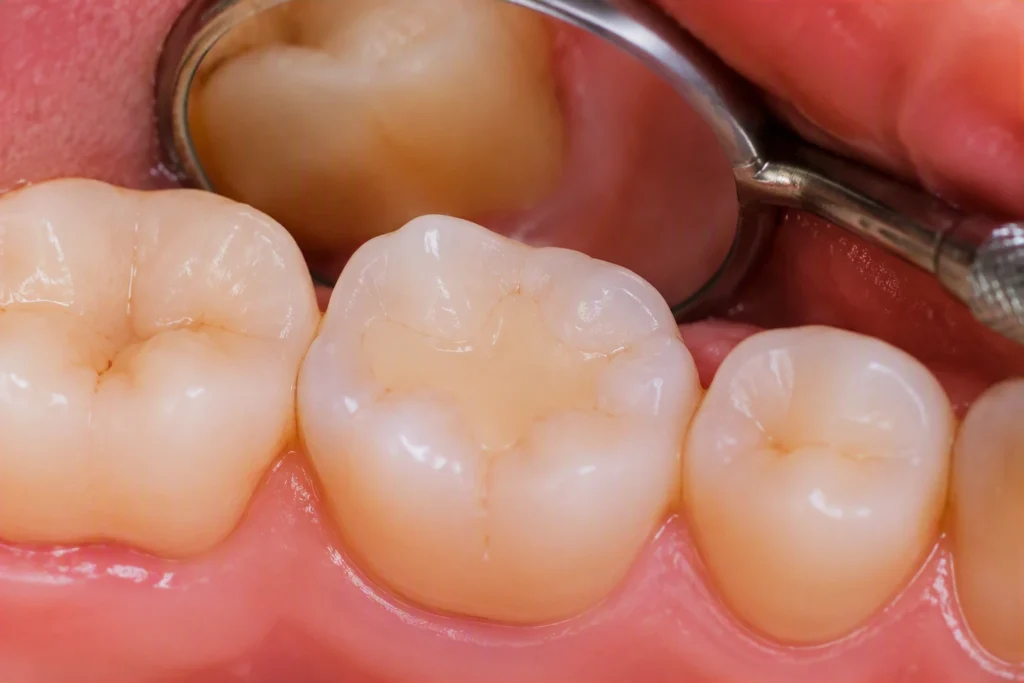
What does a dental filling look like?
Many patients choose tooth-coloured composite resin fillings because they can be matched to the natural colour of the tooth. This can make the restoration much less noticeable when you smile or talk.
Other materials, including glass-ionomer and amalgam, may be appropriate in particular situations. Gold and porcelain restorations may also be considered when a tooth requires a different type of restoration.
Why Might You Need a Tooth Filling?
The most common reason for needing a filling is tooth decay.
However, a filling may also be considered when a tooth has:
- a small crack or fracture
- damage caused by an accident
- a worn area
- an old filling that needs replacement
- a cavity caused by decay
- another relatively small area of tooth damage
Sometimes a cavity does not cause noticeable symptoms in its early stages. This is why regular dental examinations are important. A dentist may identify decay during an examination or with dental imaging before you develop significant toothache.
If decay progresses deeper into the tooth, a simple filling may no longer be enough. Depending on the extent of the damage, treatment could involve an inlay, onlay, crown or root canal treatment instead.
What Are the Signs You May Need a Dental Filling?
You may need to see a dentist if you notice:
- sensitivity to hot or cold
- sensitivity when eating sweet foods
- pain when biting
- a visible hole or dark area in a tooth
- food repeatedly getting trapped between teeth
- a chipped or damaged tooth
- toothache
- a rough or broken area on a filling
- an old filling that has become damaged
However, symptoms alone cannot tell you whether you need a filling. A dental examination is needed to determine the cause of the problem and how extensive the damage is.
How Does a Tooth Filling Work?
The exact process depends on the tooth, the size and location of the cavity, the filling material and your individual circumstances.
A typical tooth filling appointment may involve the following steps.
1. Examination
Your dentist examines the affected tooth and surrounding area. Depending on your symptoms and clinical findings, an X-ray may be recommended to assess areas that cannot be seen directly.
2. Local anaesthetic
If necessary, local anaesthetic is used to numb the area around the tooth.
This helps make the treatment more comfortable.
3. Removing the decay
The dentist carefully removes the decayed or damaged portion of the tooth.
The aim is to remove the affected tissue while preserving as much healthy natural tooth structure as possible.
4. Preparing the tooth
The tooth is cleaned and prepared so the restorative material can be placed correctly.
5. Placing the filling
The selected filling material is placed into the prepared area.
For composite resin, the material is normally placed and shaped before being hardened with a curing light.
6. Shaping and checking the bite
Your dentist shapes the filling so that it restores the tooth’s natural contours.
Your bite is also checked to make sure the restored tooth does not feel unusually high when you close your mouth.
7. Final check
The dentist checks the restoration and makes any necessary adjustments.
The goal is to restore the tooth so it looks, feels and functions as naturally as possible.
How Long Does It Take to Fill a Tooth?
One of the most common questions patients ask is:
“How long does it take to fill a tooth?”
There is no single treatment time that applies to every patient.
A small, straightforward filling can often be completed during one appointment. A larger or more complicated restoration may take longer.
Treatment time can depend on:
- the size of the cavity
- the location of the tooth
- how many surfaces are affected
- the type of filling material
- whether an X-ray or additional assessment is needed
- whether the tooth requires more extensive treatment
For this reason, it is better to ask your dentist how long your particular filling is likely to take rather than relying on a generic appointment time.
How Much Does a Tooth Filling Cost in Melbourne?
Tooth filling cost in Melbourne can vary considerably from one patient to another.
There is no single price for every dental filling because the cost can depend on the amount of tooth affected, the number of surfaces being restored, the filling material, the location of the tooth and the complexity of the treatment.
For example, a small filling affecting one surface is generally a different restoration from a larger filling involving several surfaces.
Current Melbourne dental practices publish different indicative prices, demonstrating why patients should receive an individual treatment estimate rather than assuming that every dental filling costs the same.
What affects the cost of a dental filling?
The dental filling price may be influenced by:
- Size of the filling: A larger cavity generally requires more restorative work.
- Number of surfaces: A filling involving several surfaces can be more involved than a small single-surface restoration.
- Location of the tooth: The position and function of the tooth can affect the complexity of treatment.
- Material: Different restorative materials have different properties and costs.
- Extent of damage: If the tooth has more extensive structural damage, a filling may not be the most suitable option.
- Additional treatment: An examination, X-ray or other dental treatment may be required depending on your circumstances.
- For an accurate tooth filling cost in Melbourne, the best approach is to have the tooth examined and discuss the recommended treatment and associated fees with your dentist before proceeding.
At Hope Street Family Dental, treatment costs are discussed with patients, with the practice stating that it aims to provide transparent pricing and flexible payment options.
How Much Is a Tooth Filling in Melbourne?
If you are searching “how much is a tooth filling?”, the honest answer is that the price depends on your individual treatment.
Published Melbourne prices can provide a general indication, but they should not be treated as a universal price for every dental filling.
For example, some Melbourne practices currently advertise tooth-coloured composite fillings from $220 to $495 depending on factors including the size of the restoration and number of surfaces involved.
That does not mean every Melbourne dentist will charge within that range. Different clinics, materials, treatment requirements and patient circumstances can produce different fees.
If you are considering treatment at Hope Street Family Dental in Brunswick, contact the clinic for an assessment and an individualised estimate.
What Types of Tooth Fillings Are Available?
There are several materials that may be used for dental fillings.
Composite resin fillings
Composite resin is a tooth-coloured material that can be matched to the appearance of your natural teeth.
It is widely used when aesthetics are important and can be bonded to the tooth.
Glass-ionomer fillings
Glass-ionomer cement is another tooth-coloured material. It is not as strong as composite resin and may be used for temporary fillings or other dental applications.
Amalgam fillings
Amalgam is a metal-based filling material that has been used in dentistry for many years.
It remains a strong restorative material, although it has become less common as tooth-coloured alternatives have become more widely used.
Gold and porcelain restorations
Gold and porcelain can be used for longer-lasting restorations in selected cases. These restorations may require laboratory fabrication and more than one appointment.
Your dentist can explain which material is appropriate based on the tooth being treated, the extent of the damage, aesthetics, function and your individual circumstances.
How Long After a Tooth Filling Can You Eat?
This is one of the most searched questions after dental treatment.
In many cases, you can eat once the numbness from the local anaesthetic has worn off.
For a modern composite filling, the material is hardened during treatment, so there usually isn’t a prolonged waiting period for the filling itself to set. The bigger concern immediately after treatment is often the anaesthetic.
Eating while your mouth is still numb can make it easy to accidentally bite your cheek, tongue or lip without realising it.
How long should you wait before eating after a composite filling?
If you have received a composite tooth filling, you can generally eat once the numbness has disappeared.
The exact time varies depending on the anaesthetic used and how your body responds.
Some patients regain normal sensation within a couple of hours, while it can take longer for others.
Your dentist’s instructions should take priority.
How long should you wait after an amalgam filling?
Amalgam behaves differently from composite resin.
Because amalgam takes longer to reach its full strength, your dentist may recommend avoiding hard chewing on the treated side for around 24 hours.
If you have received a different type of filling, ask your dentist for specific aftercare instructions.
What Can You Eat After a Tooth Filling?
Once the anaesthetic has worn off, you can generally return to eating, subject to your dentist’s instructions.
If your tooth feels sensitive, you may find it more comfortable to start with softer foods such as:
- yoghurt
- eggs
- pasta
- soft vegetables
- soup that is not extremely hot
- soft rice
- mashed vegetables
- other foods that require minimal chewing
For the first day, you may prefer to avoid particularly hard, sticky or very hot or cold foods if the treated tooth feels sensitive.
You do not necessarily need to change your entire diet after a filling. The main aim is to avoid unnecessary pressure or discomfort while the tooth settles.
Can You Eat Immediately After a Tooth Filling?
If you have a composite filling, the filling itself is hardened during treatment. However, you should still wait until the local anaesthetic has worn off before chewing normally.
This is particularly important because numbness can prevent you from noticing that you are biting your cheek, tongue or lip.
If your dentist has given you different instructions based on your filling material or treatment, follow those instructions.
Is Tooth Sensitivity Normal After a Filling?
Some sensitivity after a filling can be normal.
You may notice temporary sensitivity when:
- drinking something cold
- drinking something hot
- eating sweet foods
- biting down
Healthdirect Australia notes that sensitivity can occur after dental fillings and recommends seeing your dental professional if the sensitivity continues after a few days.
The depth of the cavity, the tooth involved and other factors can affect how the tooth feels after treatment.
When should you contact your dentist?
Contact your dentist if:
- pain is severe
- sensitivity is getting worse rather than improving
- your tooth remains significantly sensitive
- your bite feels unusually high
- the filling feels loose
- the filling chips or breaks
- swelling develops
- you develop significant or persistent toothache
A filling should not simply be ignored if something feels wrong after treatment.
What Happens If You Don’t Get a Tooth Filled?
If a dentist has recommended a filling because of tooth decay, delaying treatment may allow the damage to progress.
A small cavity can become larger and involve more of the tooth.
As decay progresses deeper, treatment can become more extensive. Depending on how much of the tooth has been affected, you may eventually need a larger restoration, crown or root canal treatment rather than a straightforward filling.
This is one reason early diagnosis and treatment can be valuable.
How Long Do Dental Fillings Last?
Dental fillings do not last forever.
Their lifespan can depend on factors such as:
- the filling material
- the size of the restoration
- the location of the tooth
- chewing forces
- teeth grinding or clenching
- oral hygiene
- diet
- whether the tooth develops further decay
- general dental health
Expert dentists note that fillings can eventually become chipped, worn or discoloured and may need replacement.
Regular dental examinations allow your dentist to monitor existing fillings and identify problems before they become more serious.
How Can You Look After a Dental Filling?
Good oral hygiene is important after receiving a filling.
Brush twice a day
Use fluoride toothpaste and brush carefully around the restored tooth.
Clean between your teeth
Floss or use another dentist-recommended interdental cleaning method to remove plaque and food debris between the teeth.
Reduce frequent sugary snacks
Frequent exposure to sugar can contribute to tooth decay. A filling repairs existing damage but does not make a tooth immune to future decay.
Attend regular dental check-ups
Your dentist can monitor the filling and look for signs of new decay or problems with other teeth.
Protect your teeth from excessive forces
If you grind or clench your teeth, discuss this with your dentist. Excessive forces can contribute to wear or damage to teeth and restorations.
Tooth Filling vs Dental Crown: Which Do You Need?
A filling and a crown are not interchangeable.
A filling is generally used to repair a smaller or moderate area of tooth damage.
A crown covers and protects a much larger portion of a tooth and may be recommended when the tooth has significant structural damage.
If a tooth is too damaged for a conventional filling, your dentist may discuss alternatives such as an inlay, onlay or crown.
The correct choice depends on the amount of healthy tooth structure remaining and the function of the tooth.
Tooth Filling vs Root Canal Treatment
A filling repairs the damaged portion of a tooth.
A root canal treatment is different because it involves treating the infected or damaged tissue inside the tooth.
If decay has progressed deep enough to affect the dental pulp, a filling alone may not resolve the problem.
Hope Street Family Dental also provides root canal treatment in Brunswick, and its clinical information explains that root canal treatment may be recommended when the nerve tissue inside a tooth is infected, dead or dying.
Your dentist can determine which treatment is appropriate after examining the tooth.
Are Tooth-Coloured Fillings a Good Option?
For many patients, composite resin can be an attractive option because the material is tooth coloured.
The final choice should not be based only on appearance, however.
Your dentist will consider the tooth’s location, how much structure needs to be restored, chewing forces, the size of the restoration and other clinical factors before recommending a material.
Dental Fillings in Brunswick, Melbourne
If you are searching for tooth filling treatment in Brunswick, Melbourne, Hope Street Family Dental provides dental fillings as part of its general and restorative dental services.
The clinic is located at G1/10–14 Hope Street, Brunswick, Victoria 3056, and provides dental care for patients across Brunswick and surrounding Melbourne suburbs.
Dr Aziz Baluch is the practice’s principal dentist. He graduated from the University of Sydney in 2005 and has worked across private practices and public hospitals before returning to Melbourne. His experience includes general dental care, root canals, crowns and bridges, extractions, children’s dentistry, orthodontic treatment, implants and cosmetic dentistry.
If you have tooth sensitivity, a suspected cavity, a damaged filling or toothache, a dental examination can help determine whether a filling is appropriate or whether another treatment would be more suitable.
Frequently Asked Questions About Tooth Fillings
A tooth filling is a dental restoration used to repair a tooth affected by decay or damage. The dentist removes the damaged portion and fills the area with an appropriate restorative material.
The cost varies depending on the size and location of the cavity, the number of surfaces involved, the filling material and the complexity of treatment. An examination is needed to provide an accurate estimate for your tooth.
There is no universal tooth filling price. Melbourne dentists may charge different fees depending on the restoration required. Ask your dentist for an individual treatment estimate before proceeding.
A straightforward filling can often be completed in one appointment, but treatment time varies according to the size, location and complexity of the cavity and the filling material used.
With a composite filling, you can generally eat once the local anaesthetic has worn off. If an amalgam filling is used, your dentist may advise avoiding hard chewing on that side for longer while it sets.
You should generally wait until the numbness has worn off before chewing. This helps prevent accidentally biting your cheek, lip or tongue.
The duration varies depending on the local anaesthetic and the individual patient. It can commonly take a few hours for normal sensation to return. Your dentist can give you more specific guidance based on the anaesthetic used.
Mild sensitivity to hot, cold, sweet foods or biting can occur after a filling. It should generally improve. If sensitivity persists, becomes severe or worsens, contact your dentist.
Yes. Fillings can become damaged, chipped or loose over time. If your filling falls out, contact your dentist so the tooth can be assessed and repaired.
No. Dental fillings can wear, chip, crack or develop problems over time. Regular dental examinations allow your dentist to monitor them.
Some temporary sensitivity can occur after a filling. However, significant, persistent or worsening pain should be assessed by your dentist.