

If you have severe toothache, sensitivity to hot or cold, swelling around a tooth or pain when biting, you may need root canal treatment.
It removes infected or inflamed pulp from inside a tooth, cleans and seals the root canals, and aims to preserve the natural tooth.
For patients searching for root canal treatment in Brunswick, one of the biggest questions is cost. The price can vary considerably depending on which tooth needs treatment, how complicated the infection is, how many canals need to be treated and whether the tooth needs a crown or another restoration afterwards.
This guide explains what the treatment involves, root canal treatment cost in Australia, when you may need it, what recovery is like and what to expect when having treatment in Brunswick.
What Is Root Canal Treatment?
Root canal treatment, also called endodontic treatment, is a procedure used to treat infection or inflammation inside a tooth.
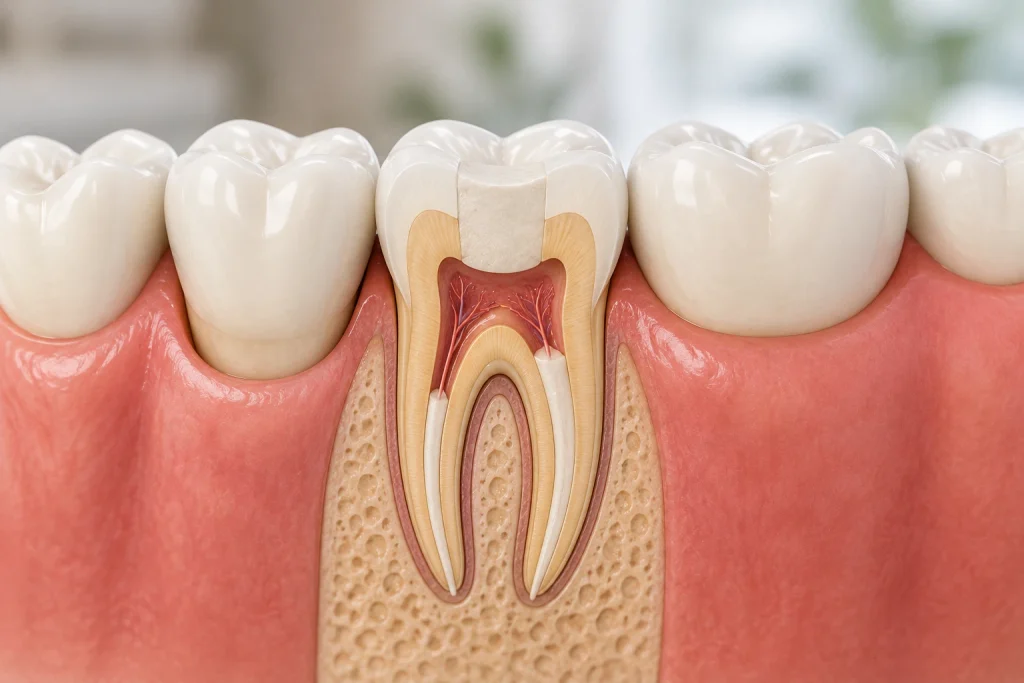
The inside of a tooth contains soft tissue called dental pulp, which includes nerves and blood vessels. If bacteria reach the pulp through deep decay, cracks, trauma or other damage, the tissue can become inflamed or infected.
During root canal treatment, the dentist removes the damaged or infected pulp, cleans and shapes the root canals, and seals them to help prevent further infection.
The aim is to save the natural tooth rather than remove it.
At Hope Street Family Dental, root canal treatment is available in Brunswick for teeth with infected, dead or damaged nerve tissue. Treatment may require one or several appointments depending on the tooth and complexity of the case.
Why Do You Need a Root Canal?
A root canal may be recommended when the pulp inside a tooth has become irreversibly damaged or infected.
Common causes include:
- Deep tooth decay
- A cracked or fractured tooth
- Dental trauma
- Repeated dental procedures on the same tooth
- Significant wear or damage
- Bacteria reaching the inner pulp through a damaged tooth
Not every toothache requires root canal treatment. Tooth pain can have several causes, so a dental examination is needed to determine what is actually happening.
If you’re experiencing ongoing tooth pain, a general dental consultation in Brunswick can help identify the cause and determine whether root canal treatment or another treatment is appropriate.
What Are the Symptoms of an Infected Tooth?
Symptoms vary between patients. Some people experience significant pain, while others may have an infection without obvious symptoms.
Possible signs include:
- Severe or persistent toothache
- Pain when biting or chewing
- Sensitivity to hot or cold
- Sensitivity that continues after the hot or cold stimulus is removed
- Swelling around the tooth
- Tender or swollen gums
- A pimple or abscess on the gum
- Tooth discolouration
- Pain that spreads to the jaw, ear or surrounding area
- A bad taste in the mouth
Sometimes an infected tooth causes little or no pain.
This is one reason regular dental examinations are important. Your dentist may identify a problem before it develops into a larger infection.
Can a Root Canal Save Your Tooth?
In many cases, root canal treatment can allow a damaged or infected tooth to remain in place.
Without treatment, an infection inside a tooth can continue and damage surrounding tissues and bone. Healthdirect explains that root canal treatment can help save an infected or damaged tooth, while extraction may require additional treatment to replace the missing tooth.
However, whether a tooth can be saved depends on factors such as:
- How much healthy tooth structure remains
- The extent of the infection
- The condition of the roots
- Whether the tooth is cracked
- The surrounding bone and gum health
- Whether the tooth can be properly restored after treatment
Your dentist will assess these factors before recommending treatment.
How Does Root Canal Treatment Work?
Root canal treatment is generally completed through several stages.
1. Examination and diagnosis
Your dentist first examines the tooth and may take dental X-rays or other diagnostic images.
The purpose is to determine the source of the pain or infection and assess the condition of the tooth and surrounding structures.
2. Local anaesthetic
The area around the affected tooth is numbed before treatment.
This helps make the procedure more comfortable.
3. Accessing the tooth
The dentist creates a small opening in the tooth to access the infected or damaged pulp and root canal system.
4. Cleaning the root canals
The infected or damaged pulp is removed.
The canals are then cleaned and shaped so they can be properly sealed.
5. Sealing the canals
After the canals have been cleaned, they are filled and sealed to reduce the risk of bacteria entering the treated area again.
6. Restoring the tooth
After root canal treatment, the tooth needs a strong and durable restoration.
Depending on how much tooth structure remains and which tooth has been treated, this may involve a filling, onlay or crown.
Hope Street Family Dental explains that teeth undergoing root canal treatment can be weakened by the loss of tooth structure and may require a more complex restoration such as an onlay or crown.
You can learn more about restoring damaged teeth through the practice’s restorative dentistry service.
How Much Does Root Canal Treatment Cost in Australia?
The answer to “how much is root canal treatment in Australia?” depends on the individual tooth and treatment required.
There is no single national price for root canal treatment.
The cost can be affected by:
- Which tooth requires treatment
- Number of root canals
- Complexity of the tooth’s root anatomy
- Severity of the infection
- Number of appointments required
- Whether additional treatment is needed
- Whether a filling, onlay or crown is required afterwards
- Whether a specialist endodontic referral is necessary
As a general indication, current Australian cost guides place root canal treatment in a broad range of approximately $1,500 to $3,500, although actual fees vary between practices and cases. A Victorian estimate within that guide is approximately $1,540 to $3,600. These figures are estimates rather than a fixed price for treatment at Hope Street Family Dental.
The most accurate way to determine your root canal treatment cost is to have the tooth examined and receive an individual treatment plan.
Why Does Root Canal Treatment Cost More for Some Teeth?
Not every tooth has the same root structure.
A front tooth may have a relatively straightforward canal system, while a molar can have several canals and more complex root anatomy.
This can make treatment more technically demanding and time-consuming.
The condition of the tooth also matters. A tooth with significant structural damage may need additional restorative treatment after the root canal.
For example, a tooth that requires a crown will have an additional cost beyond the root canal procedure itself.
Hope Street Family Dental provides dental crowns and restorative treatment in Brunswick for teeth that require additional protection or restoration.
Does a Root Canal Include a Crown?
Not necessarily.
A crown is a separate restoration from the root canal procedure.
Whether you need one depends on the condition and location of the tooth.
Back teeth such as molars often experience substantial chewing forces, and a crown may be recommended when there is insufficient remaining tooth structure to provide adequate protection with a filling alone.
Other teeth may be restored with a filling or another restoration depending on their condition.
Your dentist should explain the recommended restoration and its cost before treatment proceeds.
What Happens If You Don’t Have a Root Canal?
If a dentist has diagnosed an infected or irreversibly damaged pulp, delaying treatment may allow the problem to progress.
An untreated infection can lead to:
- Increasing pain
- Dental abscess
- Swelling
- Damage to surrounding bone
- Spread of infection into surrounding tissues
- Eventual tooth loss
Antibiotics do not remove the infected pulp inside the tooth. They may sometimes be prescribed when there is a spreading infection or other clinical indication, but they do not replace definitive dental treatment for an infected tooth.
Hope Street Family Dental explains that antibiotics may help the body control an infection but do not cure the infected tooth itself.
If you’re experiencing significant swelling, severe dental pain or another urgent dental problem, contact an emergency dentist in Brunswick for an assessment.
Is Root Canal Treatment Painful?
The purpose of modern root canal treatment is to remove the source of infection and pain while keeping you comfortable during the procedure.
Local anaesthetic is used to numb the treatment area.
After treatment, you may experience some tenderness or sensitivity around the tooth, particularly when biting. This usually settles as the surrounding tissues recover.
If you experience severe, worsening or persistent pain after treatment, contact your dentist.
How Long Does Root Canal Treatment Take?
Treatment time varies according to the tooth and complexity of the case.
A straightforward tooth may require fewer appointments, while a more complex tooth or infection may require additional visits.
Hope Street Family Dental states that root canal treatment may take between one and four appointments, with some complex cases requiring more.
Your dentist can provide a more accurate estimate after examining the tooth.
What Should You Do After Root Canal Treatment?
Your tooth may feel tender for a few days after root canal treatment. Following your dentist’s instructions and protecting the treated tooth can help support recovery.
1. Avoid chewing on the treated tooth
If the tooth has not yet received its permanent restoration, avoid chewing hard or sticky foods on that side. A root-treated tooth can be more vulnerable to fracture until it has been properly restored.
2. Choose softer foods if the tooth feels tender
For the first day or two, foods such as yoghurt, eggs, pasta, soft vegetables and soups may be more comfortable if chewing causes tenderness.
3. Continue brushing and flossing
Don’t stop your normal oral hygiene routine. Brush twice a day with fluoride toothpaste and clean between your teeth daily, taking care around the treated area.
4. Take medication only as directed
If your dentist recommends pain relief, follow their instructions. Don’t exceed the recommended dose or combine medications unless you have been advised that it is safe to do so.
5. Attend your follow-up appointment
If your root canal was completed over multiple appointments or the tooth requires a permanent restoration, attend the recommended follow-up. Delaying the final restoration can leave the tooth vulnerable to further damage.
6. Have the permanent restoration placed when recommended
A root canal treats the inside of the tooth, but the tooth may still need additional protection. Depending on the amount of remaining tooth structure and its location, your dentist may recommend a filling, onlay or crown.
7. Watch for unusual symptoms
Some tenderness after treatment can be expected. Contact your dentist if you develop increasing pain, significant swelling, fever, a bad taste, or symptoms that do not improve.
8. Protect the tooth long term
Once treatment is complete, maintain regular dental check-ups and good oral hygiene. Avoid using your teeth to bite hard objects, and consider a mouthguard if you participate in contact sports.
If you need ongoing preventive care, professional teeth cleaning can form part of your regular oral health routine.
Can a Root Canal Fail?
Root canal treatment has a high success rate when the tooth can be adequately cleaned, sealed and restored, but no dental treatment can guarantee that a tooth will never develop another problem.
A previously treated tooth may require further assessment if:
- Infection remains or returns
- The tooth develops a new fracture
- The restoration leaks or fails
- New decay develops
- The original canal system was particularly complex
In some cases, additional root canal treatment or endodontic surgery may be considered.
Hope Street Family Dental notes that endodontic surgery may sometimes be required when conventional root canal treatment does not completely eliminate infection.
Root Canal Treatment vs Tooth Extraction
When a tooth is infected, the two main options may be root canal treatment or extraction, depending on whether the tooth can be predictably restored.
Root canal treatment
The infected pulp is removed while the natural tooth is retained.
Potential advantages include:
- Keeping your natural tooth
- Maintaining normal chewing function
- Avoiding a gap caused by extraction
- Avoiding the immediate need for tooth replacement
Tooth extraction
The entire tooth is removed.
If the tooth is extracted, you may later need to consider a replacement such as a dental implant, bridge or denture depending on its location and your individual needs.
How Can You Avoid Needing Root Canal Treatment?
Not every root canal can be prevented, but good oral hygiene and regular dental care can reduce the risk of extensive tooth decay and other problems that can damage the pulp.
Useful habits include:
- Brush twice a day with fluoride toothpaste
- Clean between your teeth daily
- Limit frequent consumption of sugary foods and drinks
- Attend regular dental examinations
- Have tooth decay treated early
- Wear appropriate protection during contact sports
- Don’t ignore persistent tooth pain
- Seek treatment promptly if a tooth is cracked or damaged
Root Canal Treatment in Brunswick
If you’re searching for root canal treatment in Brunswick, choosing a dentist who can assess the tooth, explain your options and plan the required restoration is important.
Hope Street Family Dental provides root canal treatment at its Brunswick practice at G1/10–14 Hope Street, Brunswick VIC 3056.
The practice provides general, restorative and emergency dental care, allowing patients to have related dental problems assessed and treated within the same practice where appropriate.
Dr Aziz Baluch, Principal Dentist at Hope Street Family Dental, has experience providing general dental care including root canals, crowns, bridges and dental extractions.
If you have tooth pain or have been told you may need a root canal, an examination can determine whether the tooth can be treated and what restoration it will require.
When Should You See a Dentist?
Don’t wait for severe pain before arranging an appointment.
You should arrange a dental assessment if you have:
- Persistent toothache
- Pain when chewing
- Prolonged sensitivity to hot or cold
- Swelling around a tooth
- A recurring gum abscess
- A cracked or damaged tooth
- Tooth discolouration
- Pain that keeps returning
If you have facial swelling, difficulty swallowing or breathing, fever with significant swelling, or other signs of a potentially spreading infection, seek urgent medical or dental care.
How to Book a Root Canal Consultation in Brunswick?
Persistent tooth pain should not be ignored.
If you think you may need root canal treatment in Brunswick, Hope Street Family Dental can assess the affected tooth, explain your treatment options and discuss the expected cost before proceeding.
The practice is located at G1/10–14 Hope Street, Brunswick VIC 3056.
You can call on (03) 9381 0779 to book root canal consultation in Brunswick.
Root Canal Treatment FAQs
Root canal treatment costs vary depending on the tooth, number of canals, complexity and additional treatment required. Current Australian cost guides give a broad estimate of around $1,500 to $3,500, but actual fees vary between practices and individual cases.
The cost depends on the individual tooth and treatment required. A consultation and examination are needed to provide an accurate treatment plan and fee. Additional restorative treatment, such as a crown, may increase the total cost.
Treatment may take one or several appointments depending on the tooth and complexity of the case. Hope Street Family Dental states that some cases may require one to four appointments or occasionally more.
If the tooth has enough healthy structure and can be predictably restored, root canal treatment may allow you to keep your natural tooth. Your dentist needs to assess the tooth before confirming whether it can be saved.
Not every root-treated tooth requires a crown. The recommended restoration depends on the tooth, remaining structure and amount of chewing force it will experience. Your dentist can explain whether a filling, onlay or crown is appropriate.
Antibiotics do not remove infected pulp from inside a tooth. When root canal treatment is indicated, definitive dental treatment is generally required to address the source of infection.
If a tooth can be predictably restored, preserving the natural tooth with root canal treatment may be an option. If the tooth cannot be restored, extraction may be necessary. Your dentist can explain the advantages, risks and long-term implications of each option.
An untreated infected tooth can continue to cause pain and may develop an abscess or spread infection into surrounding tissues. Early assessment can help determine the appropriate treatment before the problem becomes more complicated.