
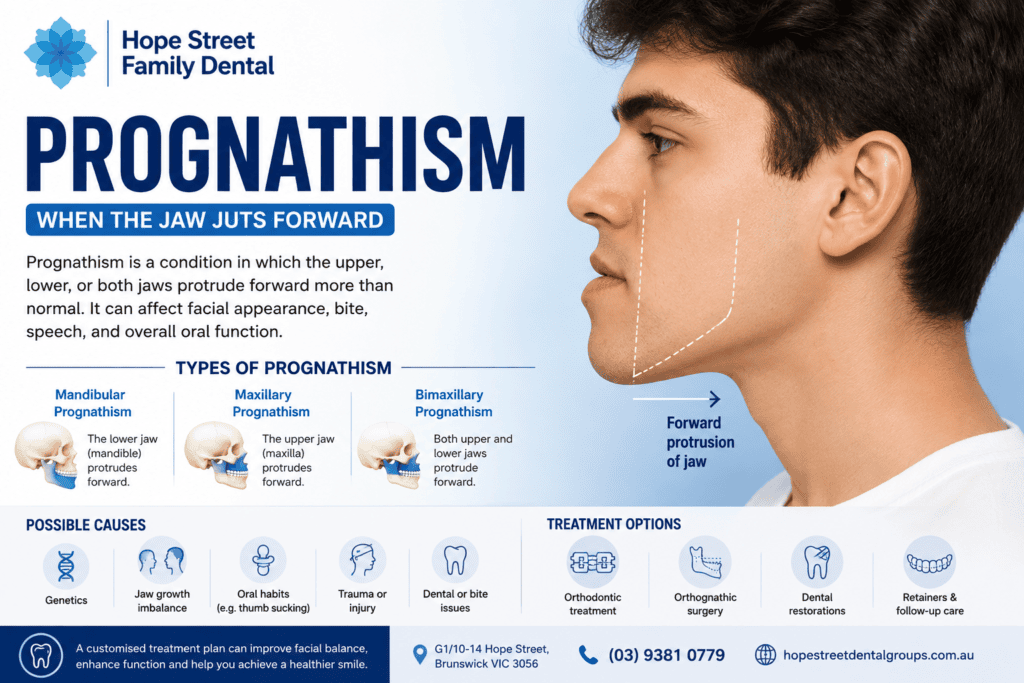
Have you noticed that your lower jaw appears to sit further forward than usual, or that your upper jaw seems more prominent? A forward-positioned jaw can affect the appearance of the face, the way the teeth meet and, in some cases, everyday functions such as biting, chewing or speaking.
This type of jaw relationship may be associated with prognathism, a condition in which the upper jaw, lower jaw or both jaws project forward more than expected.
But what does prognathism actually mean, what causes it, and can it be corrected?
In this guide, I will explain the different types of prognathism, how dentists and orthodontists assess the condition, how to fix prognathism, and what treatment may be considered for maxillary prognathism and mandibular prognathism.
What Does Prognathism Mean?
Prognathism means that the upper jaw, lower jaw or both jaws protrude forward more than usual.
The term describes the position or projection of a jaw rather than one specific disease. Prognathism can range from mild and barely noticeable to a more significant skeletal discrepancy that affects the bite and facial profile.
Depending on which jaw is affected, prognathism may be described as:
- Mandibular prognathism – the lower jaw projects forward.
- Maxillary prognathism – the upper jaw projects forward.
- Bimaxillary prognathism – both the upper and lower jaws project forward.
In some people, prognathism is primarily an appearance concern. In others, it may be associated with a malocclusion, meaning the upper and lower teeth do not meet correctly.
A detailed examination is therefore important before deciding whether treatment is necessary.
What Is Mandibular Prognathism?
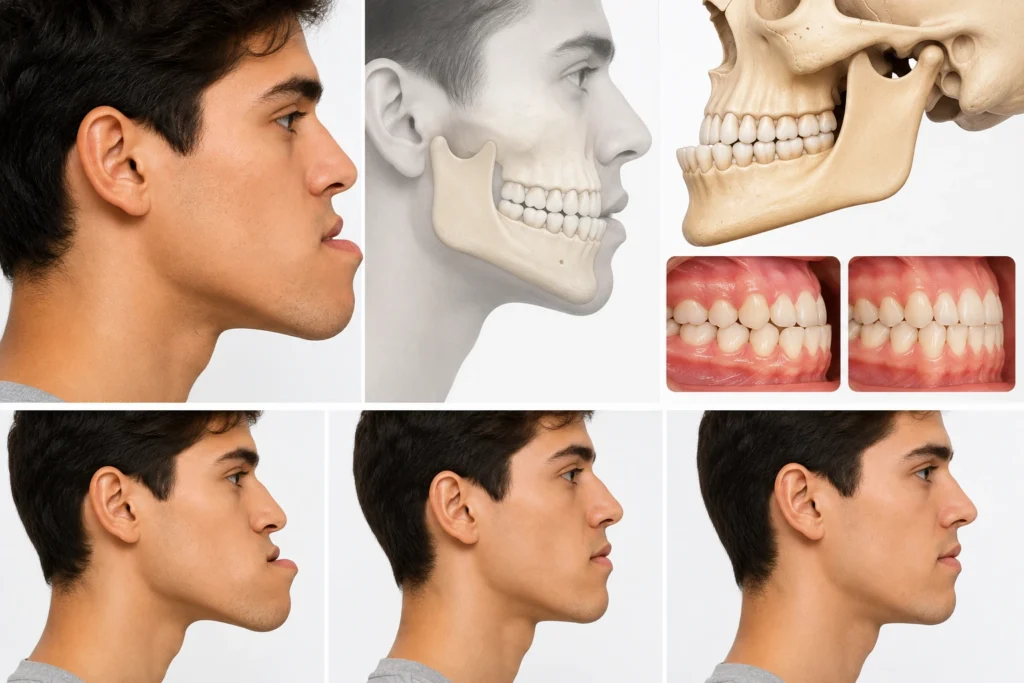
Mandibular prognathism is a condition in which the lower jaw, or mandible, projects forward relative to the upper jaw.
It is often associated with a Class III bite, in which the lower teeth sit in front of the upper teeth when the mouth is closed.
Mandibular prognathism can occur because the lower jaw is positioned or developed further forward, because the upper jaw is positioned further back, or because both jaws contribute to the skeletal relationship.
In some people, the condition is relatively mild. In more pronounced cases, it can affect facial profile and dental function.
Possible features can include:
- A prominent lower jaw
- A less prominent or recessed-looking midface
- An underbite or reverse bite
- Difficulty biting with the front teeth
- Difficulty chewing
- Uneven tooth wear
- Facial imbalance
- Speech concerns in some cases
- Jaw joint symptoms in some individuals
Mandibular prognathism can have a genetic component, although jaw development is influenced by multiple factors.
Can Mandibular Prognathism Be Corrected?
Treatment depends heavily on the patient’s age and whether the problem is primarily dental or skeletal.
In growing children and adolescents, selected growth-modification or dentofacial orthopaedic approaches may sometimes influence jaw development. In adults with a significant skeletal discrepancy, orthodontic treatment combined with orthognathic surgery may be required when orthodontics alone cannot reposition the underlying jaw bones.
This is why an early assessment can be valuable, particularly when a child has an obvious underbite or developing jaw imbalance.
What Is Maxillary Prognathism?
Maxillary prognathism occurs when the upper jaw, or maxilla, projects forward more than expected.
The maxilla forms the upper jaw and supports the upper teeth. When the upper jaw is positioned too far forward, it can influence the facial profile and the relationship between the upper and lower teeth.
Maxillary prognathism can occur by itself or as part of a broader jaw relationship involving both jaws.
It is important to distinguish maxillary prognathism from maxillary hypoplasia, where the upper jaw is underdeveloped or positioned too far backwards. A person may have a Class III bite because of a forward-positioned mandible, an underdeveloped maxilla, or a combination of both.
An orthodontist or dental professional can use clinical examination and appropriate imaging to determine which structures are contributing to the bite and facial profile.
What Causes Prognathism?
There is not always one single cause of prognathism.
Possible contributing factors include:
Genetics
Jaw shape and facial development can run in families. A family history of prominent jaws or certain bite patterns may increase the likelihood of developing a similar skeletal relationship.
Differences in Jaw Growth
The upper and lower jaws do not always grow at exactly the same rate or in the same direction. Differences in growth can create an imbalance between the jaws.
Dental Development
Sometimes the appearance of a protruding jaw is influenced by the position of the teeth rather than the jaw bones themselves.
Oral Habits
Certain childhood oral habits can influence dental development and bite relationships, although the significance varies from person to person.
Trauma or Other Conditions
Jaw trauma and some underlying conditions can affect facial growth and development.
Because several factors can contribute to a similar appearance, professional assessment is needed to determine the underlying cause.
What Problems Can Prognathism Cause?
Mild prognathism may not cause significant functional problems. However, a more pronounced jaw discrepancy can affect the relationship between the teeth and the way the mouth functions.
Potential concerns include:
- Difficulty biting or chewing
- An underbite or other malocclusion
- Uneven tooth wear
- Difficulty closing the lips comfortably
- Speech difficulties in some cases
- Facial imbalance
- Jaw joint or muscle discomfort in some people
- Difficulty maintaining effective oral hygiene in certain areas
Not everyone with prognathism requires treatment. The decision depends on the severity of the condition, its effect on oral function and the patient’s individual goals.
How Is Prognathism Diagnosed?
Prognathism cannot always be accurately assessed simply by looking at someone’s profile.
A dental or orthodontic assessment may include:
Clinical Examination
The dentist or orthodontist evaluates the facial profile, jaw relationship, bite and position of the teeth.
Dental Examination
The teeth are assessed for crowding, spacing, crossbite, tooth wear and other signs of an abnormal bite.
Dental Imaging
Appropriate X-rays or other imaging may be used to evaluate the relationship between the upper and lower jaws.
A cephalometric radiograph, for example, provides a side view that can help assess the relationship between the facial bones and teeth.
Growth Assessment
For children and teenagers, the stage of facial growth can be particularly important when determining treatment options.
Orthodontic Assessment
An orthodontist can assess whether the problem is primarily dental, skeletal or a combination of both.
The purpose of this assessment is not simply to determine whether a jaw looks prominent. It is to understand why the jaw relationship exists and how it affects function and facial balance.
How to Fix Prognathism
There is no single treatment that fixes every case of prognathism.
The appropriate approach depends on:
- The type of prognathism
- The severity of the jaw discrepancy
- Whether the problem is dental or skeletal
- The patient’s age
- Whether the jaws are still growing
- The position of the teeth
- The patient’s functional concerns
- The patient’s treatment goals
Treatment may involve orthodontics, growth modification in selected growing patients, orthognathic surgery, or a combination of approaches.
Can Braces Fix Prognathism?
Braces can move teeth, but they cannot physically reposition the underlying jaw bones.
This distinction is important.
If the apparent jaw discrepancy is primarily caused by tooth position, orthodontic treatment may be sufficient in selected cases.
However, if the problem is a moderate or severe skeletal discrepancy, braces or clear aligners alone may not correct the underlying jaw relationship. In such cases, orthodontic treatment may be combined with corrective jaw surgery.
An orthodontist can determine whether orthodontic treatment alone is likely to achieve the desired result.
How to Fix Maxillary Prognathism
Treatment for maxillary prognathism depends on whether the forward position is caused mainly by the upper jaw, the teeth or a combination of factors.
For mild cases with a primarily dental component, orthodontic treatment may sometimes be considered.
For a significant skeletal discrepancy, treatment planning may involve an orthodontist and an oral and maxillofacial surgeon. Orthognathic surgery can reposition the jaw bones when orthodontic tooth movement alone cannot correct the underlying skeletal problem.
The exact procedure depends on the patient’s anatomy and the relationship between the upper and lower jaws.
It is therefore not appropriate to recommend one specific treatment based solely on photographs or symptoms.
How to Fix Mandibular Prognathism
Treatment for mandibular prognathism depends on whether the lower jaw is still developing and how significant the skeletal discrepancy is.
For growing patients, selected orthodontic or dentofacial orthopaedic approaches may sometimes be used to influence jaw development.
For adults with significant skeletal mandibular prognathism, orthodontic treatment may be combined with orthognathic surgery to correct the relationship between the jaws. Research on mandibular prognathism describes combined orthodontic and surgical approaches as an established treatment pathway for significant adult skeletal discrepancies.
The treatment plan should be individualised following a comprehensive orthodontic and surgical assessment where appropriate.
How Is Prognathism Treated in Children?
Children and teenagers require special consideration because their facial bones are still developing.
If a child has an underbite, prominent lower jaw or noticeable jaw imbalance, an early orthodontic assessment may help determine whether intervention could be useful during growth.
In selected growing patients with skeletal Class III patterns, growth-modification approaches may be considered. The suitability and timing depend on the child’s growth pattern, age and individual diagnosis.
Early assessment does not necessarily mean that treatment must begin immediately.
Instead, it allows a dental or orthodontic professional to monitor growth and determine the most appropriate time to intervene.
How Is Prognathism Treated in Adults?
Once facial growth is complete, the treatment options are different.
Orthodontic treatment can move teeth, but significant skeletal discrepancies generally cannot be corrected by moving the teeth alone.
For adults with moderate or severe skeletal prognathism, treatment may involve:
- Comprehensive orthodontic assessment
- Treatment planning with an orthodontist
- Orthodontic preparation where appropriate
- Orthognathic surgery to reposition the jaw bones
- Further orthodontic treatment to refine the bite
- Retention and long-term follow-up
The American Association of Orthodontists describes orthognathic surgery as corrective jaw surgery used for skeletal problems that affect functions such as biting, chewing and speaking, with orthodontic treatment commonly forming part of the overall treatment process.
What Is Orthognathic Surgery?
Orthognathic surgery is corrective jaw surgery used to reposition the upper jaw, lower jaw or both jaws when a skeletal discrepancy cannot be adequately corrected with orthodontics alone.
Depending on the diagnosis, surgery may involve the upper jaw, lower jaw or both.
The purpose can include improving:
- Bite relationship
- Chewing function
- Facial balance
- Jaw position
- Certain speech or functional problems
Orthognathic treatment is usually planned as a team approach involving orthodontic and oral/maxillofacial surgical professionals.
Because jaw surgery is a major procedure, patients should receive a comprehensive assessment and understand the expected benefits, limitations, risks and recovery requirements before making a decision.
Can Prognathism Be Fixed Without Surgery?
Sometimes, but it depends on the type and severity of prognathism.
If the problem is mild and primarily related to the position of the teeth, orthodontic treatment may sometimes improve the bite without jaw surgery.
However, braces and clear aligners cannot move a fully developed jaw bone into a new skeletal position. For significant skeletal prognathism in an adult, orthognathic surgery may therefore be necessary to correct the underlying jaw discrepancy.
This is one of the most important distinctions to understand when researching how to fix prognathism online.
Is Prognathism Only a Cosmetic Problem?
No.
Some people seek cosmetic dental treatment because they are unhappy with their facial profile, but prognathism can also have functional consequences.
A significant jaw discrepancy may affect the way the teeth meet and can contribute to difficulties with biting, chewing, speech or tooth wear.
However, not every person with a prominent jaw needs treatment.
A professional assessment can help determine whether the condition is primarily cosmetic, functional or both.
When Should You See a Dentist or Orthodontist?
Consider arranging an assessment with an Orthodontist if you or your child has:
- A noticeable underbite
- A lower jaw that appears significantly forward
- An upper jaw that appears unusually prominent
- Difficulty biting or chewing
- Teeth that do not meet comfortably
- Increasing tooth wear
- Difficulty closing the lips
- Concerns about facial or jaw development
- Jaw discomfort associated with an abnormal bite
For children, an early assessment can be particularly useful because jaw growth is still occurring.
Prognathism: The Right Treatment Starts With the Right Diagnosis
Prognathism can look different from person to person, and the most appropriate treatment depends on what is actually causing the jaw discrepancy.
Whether the concern is maxillary prognathism, mandibular prognathism, an underbite or another jaw relationship, the first step is a professional assessment.
At Hope Street Family Dental, our dental team can assess your teeth, bite and overall oral health and help determine whether further orthodontic or specialist assessment may be appropriate.
If you are concerned about your jaw position, facial profile or bite, early assessment can help you understand your options.
Dislaimer: This article is provided for general educational purposes and does not replace an individual dental, orthodontic or medical assessment. Treatment recommendations vary according to each patient’s diagnosis, age, jaw development and overall oral health.
Frequently Asked Questions About Prognathism
Prognathism means that the upper jaw, lower jaw or both jaws project forward more than expected. The condition can affect facial appearance and, in some cases, bite and oral function.
The treatment for prognathism depends on its cause, severity and the patient’s age. Mild dental cases may sometimes be managed with orthodontics, while significant skeletal cases may require a combination of orthodontic treatment and orthognathic surgery.
Maxillary prognathism is treated according to whether the forward position is caused by the upper jaw, the teeth or both.
Not exactly. Mandibular prognathism describes a forward-positioned lower jaw, while an underbite describes the relationship of the teeth. A person can have an underbite because of mandibular prognathism, an underdeveloped upper jaw, tooth position or a combination of these factors.
In selected growing children, orthodontic or dentofacial orthopaedic treatment may be considered to influence jaw development. The appropriate approach depends on the child’s growth pattern and diagnosis.
No. Some mild cases may be managed without surgery, particularly when the discrepancy is primarily dental. Significant skeletal prognathism in adults, however, may require orthognathic surgery because orthodontics alone cannot reposition the jaw bones.
Yes. A significant jaw discrepancy can cause an abnormal bite and may make biting or chewing less efficient.
Genetics can contribute to jaw shape and development, and prognathism can occur in families. However, jaw development is influenced by multiple factors, so having a family member with prognathism does not necessarily mean that another family member will develop the same condition.