
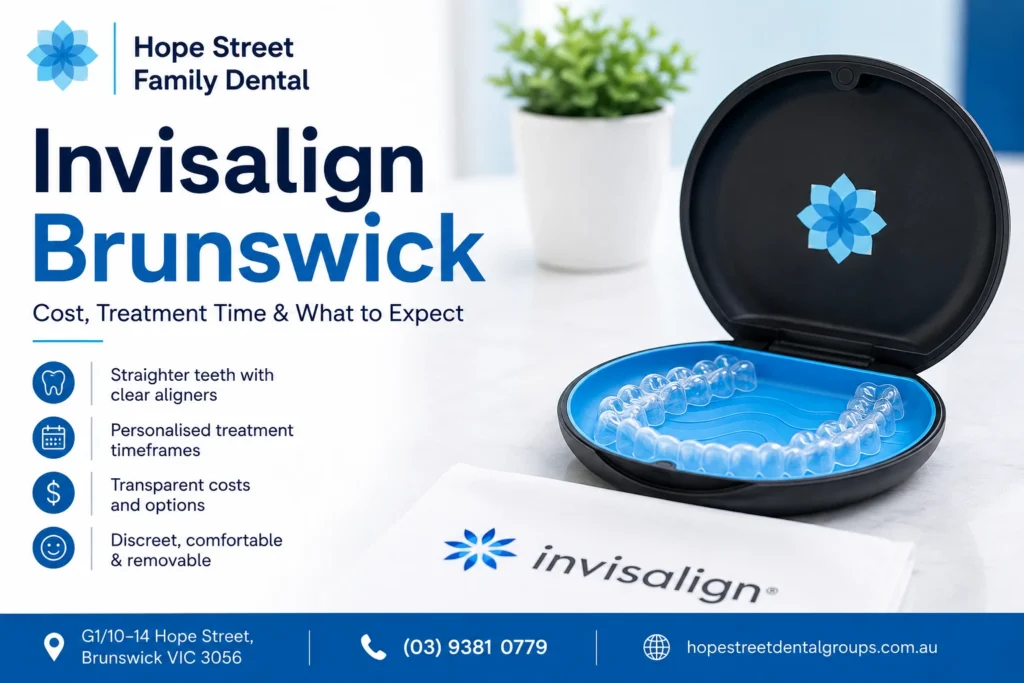
Considering Invisalign in Brunswick? Invisalign uses a series of clear, removable aligners to gradually move teeth into a planned position.
It can be suitable for many cases involving crowded, crooked or spaced teeth and some bite problems. However, suitability depends on your individual teeth, gums and bite.
Before starting treatment, most people want answers to three questions:
- Is Invisalign suitable for my teeth?
- How much does Invisalign cost in Brunswick?
- How long will treatment take?
This guide answers those questions and explains what to expect from Invisalign treatment.
What Is Invisalign?
Invisalign is an orthodontic treatment that uses a series of custom-made clear aligners instead of traditional brackets and wires.
Each aligner is designed to apply controlled pressure to specific teeth. As you progress through the series, your teeth gradually move towards their planned positions.
The aligners can be removed for eating, drinking, brushing and flossing, making them a discreet alternative to fixed braces for suitable patients.

What Can Invisalign Treat?
Invisalign can be used for a range of orthodontic concerns, depending on their severity and your individual anatomy.
These may include:
- Crowded teeth
- Gaps between teeth
- Crooked teeth
- Some overbite cases
- Some underbite cases
- Certain crossbite problems
- General tooth alignment issues
Clear aligners are not suitable for every orthodontic problem. More complex cases may require traditional braces or specialist orthodontic treatment.
The important question is therefore not simply “Can Invisalign straighten teeth?” but “Can Invisalign achieve the movement my teeth require?”
That can only be determined through a professional assessment.
Is Invisalign Right for Me?
You may be a candidate for Invisalign if you want to improve the alignment of your teeth and can consistently follow the treatment instructions.
Your dentist will assess factors including:
- Tooth position
- Crowding and spacing
- Your bite
- Gum health
- Existing dental work
- Overall oral health
- The amount and type of tooth movement required
If you have untreated tooth decay or gum disease, these issues may need to be addressed before orthodontic treatment begins.
For complex cases, your dentist may recommend an orthodontic assessment.
How Does Invisalign Treatment Work?
1. Consultation
Your dentist examines your teeth and bite and discusses what you want to change.
This is also when you can ask about treatment options, expected results, treatment time and cost.
2. Digital scan and treatment planning
A digital scan can be used to create a 3D model of your teeth and assist with treatment planning.
Your dentist uses this information to determine how your teeth need to move and whether clear aligners are appropriate.
3. Custom aligners
Your aligners are produced according to your treatment plan.
Rather than using one aligner throughout treatment, you progress through a series of aligners.
4. Wearing your aligners
You wear your aligners according to your dentist’s instructions and change them as directed.
Because the aligners are removable, treatment requires patient compliance.
5. Progress reviews
Your dentist monitors your teeth during treatment to make sure they are progressing as planned.
The frequency of appointments depends on your treatment plan and provider.
6. Retention
Once active treatment is complete, retainers are used to help maintain the position of your teeth.
Skipping retention can allow teeth to move again over time.
How Much Does Invisalign Cost in Brunswick?
There is no single Invisalign price that applies to every patient.
The cost depends on your individual treatment requirements, including:
- Complexity of your case
- Number of teeth requiring movement
- Expected treatment duration
- Number of aligners required
- Whether additional procedures are needed
- Refinements or further aligners
- Retainers and post-treatment care
For this reason, a dentist should assess your teeth before giving you a personalised treatment estimate.
Be cautious of choosing an Invisalign provider based solely on the lowest advertised price. The total cost and what is included in the treatment plan are more important.
Does private health insurance cover Invisalign?
Some Australian private health insurance policies provide benefits for orthodontic treatment.
However, cover varies between policies.
Before beginning treatment, check:
- Whether orthodontics is included
- Your annual or lifetime benefit
- Waiting periods
- Whether clear aligner treatment is covered
- Your expected out-of-pocket cost
Your dental practice can also explain the payment options available for your treatment.
How Long Does Invisalign Take?
Treatment time varies between patients.
A straightforward alignment case may take less time than a complex case involving significant crowding or bite correction.
Factors that can affect treatment time include:
- The complexity of your case
- Amount of tooth movement required
- Your treatment plan
- How consistently you wear the aligners
- How your teeth respond to treatment
- Whether refinements are required
Avoid choosing a provider based on a guaranteed treatment time without first having your teeth assessed.
Your dentist should give you an estimated timeframe based on your individual treatment plan.
Invisalign vs Braces
Both Invisalign and traditional braces can straighten teeth, but they work differently.
| Invisalign | Traditional braces |
| Clear removable aligners | Fixed brackets and wires |
| Discreet appearance | More visible |
| Can be removed for eating | Remain attached while eating |
| Easier access for brushing and flossing | Requires cleaning around brackets |
| Requires consistent patient compliance | Treatment remains fixed |
| Suitable for many alignment problems | Suitable for a broad range of orthodontic problems |
Neither option is automatically better for everyone.
The right choice depends on the movements your teeth require, your bite, your lifestyle and your dentist’s assessment.
What Are the Benefits of Invisalign?
For suitable patients, Invisalign offers several practical advantages.
Discreet appearance
The clear aligners are designed to be less noticeable than conventional braces.
Removable
You can remove the aligners when eating and for your normal oral hygiene routine.
Easier oral hygiene
Because the aligners can be removed, you can brush and floss without working around fixed brackets and wires.
No metal brackets or wires
There are no traditional brackets and archwires attached to your teeth.
Fits around daily life
For people who work with clients, attend meetings, play sport or simply prefer a discreet treatment option, removable aligners can be convenient.
However, Invisalign still requires commitment. The aligners only work when you wear them as prescribed.
What Are the Limitations of Invisalign?
Invisalign isn’t the right treatment for every patient.
Potential limitations include:
- Some complex movements may require other orthodontic approaches
- Aligners must be worn consistently
- They need to be removed when eating
- Losing an aligner can interrupt treatment
- Some patients may require attachments or additional treatment
- Refinements may sometimes be necessary
- Retainers are needed after active treatment
A proper consultation helps determine whether the benefits outweigh these limitations in your particular case.
What Happens at an Invisalign Consultation in Brunswick?
An Invisalign consultation should be more than simply being shown a set of clear trays.
Your dentist should assess your teeth and bite and discuss your treatment goals.
Depending on your case, the consultation may involve:
- Examination of your teeth and gums
- Assessment of your bite
- Digital scanning or dental records
- Discussion of your treatment objectives
- Assessment of Invisalign suitability
- Explanation of alternative treatment options
- Estimated treatment duration
- Discussion of treatment costs
- Explanation of retention after treatment
This gives you the information needed to decide whether Invisalign is appropriate before committing to treatment.
How to Choose an Invisalign Dentist in Brunswick
When comparing Invisalign providers, look beyond price.
Ask about experience
Find out how frequently the dentist provides clear aligner treatment and whether they routinely manage cases similar to yours.
Ask what is included
Make sure you understand whether the quoted fee includes scans, appointments, refinements and retainers.
Compare treatment options
A good provider should explain Invisalign alongside other appropriate orthodontic options rather than assuming clear aligners are automatically the best choice.
Consider ongoing care
Orthodontic treatment involves multiple stages. Choose a practice where you can conveniently attend reviews and receive ongoing dental care.
Look for a personalised plan
Your treatment should be based on your teeth and bite rather than a standard package.
Invisalign Brunswick at Hope Street Family Dental
If you’re looking for Invisalign in Brunswick, Hope Street Family Dental provides Invisalign as part of its dental and orthodontic services.
The practice is located at G1/10–14 Hope Street, Brunswick VIC 3056. Hope Street Family Dental Group | Dentist Brunswick
Hope Street Family Dental lists Invisalign and orthodontic treatment among its services and provides consultations to assess individual treatment needs.
During your consultation, you can discuss your concerns, treatment goals and whether clear aligners are suitable for your teeth.
Considering Invisalign in Brunswick?
If you want straighter teeth without traditional fixed braces, Invisalign may be an option worth discussing.
The first step is an assessment—not a commitment to treatment.
Book an Invisalign consultation at Hope Street Family Dental in Brunswick or call (03) 9381 0779 to discuss your options.
Frequently Asked Questions About Invisalign Brunswick
The cost varies according to the complexity of your case, required tooth movements, number of aligners and overall treatment plan. A personalised quote requires an assessment by your dentist.
Treatment time varies depending on the complexity of your case and how your teeth respond to treatment. Your dentist can provide an estimated timeframe after assessing your teeth.
Not necessarily. Invisalign is more discreet and removable, while traditional braces may be more appropriate for some complex orthodontic movements. Your dentist can recommend the option suited to your case.
Invisalign can treat many cases of crowded teeth. The suitability depends on the severity of the crowding and the movements required.
Yes, clear aligners can close certain gaps between teeth. Your dentist needs to determine the cause and extent of the spacing before recommending treatment.
Yes. Adults can be suitable candidates for Invisalign if their teeth and gums are healthy and their orthodontic problem can be treated with clear aligners.
You may experience pressure, tightness or mild discomfort when starting a new aligner. This is associated with the controlled movement of your teeth.
Aligners are removable, so you can take them out when eating. You should follow your dentist’s instructions about wearing and caring for your aligners.
Yes. Retainers help maintain the position of your teeth after active orthodontic treatment. Without retention, teeth can gradually move.
The most reliable way is to have your teeth and bite assessed by a qualified dental professional. They can determine whether Invisalign can achieve the movements you need and explain alternative options if appropriate.